
A song plays for just five seconds in a crowded restaurant, and your phone identifies its title, artist, and album before the chorus begins. It feels almost impossible, especially with conversations, clattering dishes, and traffic competing for attention.
So, how do music recognition apps identify songs with such impressive speed? They use audio fingerprinting, a technology that converts sound into distinctive digital patterns and compares them against an extensive database of recordings.
Applications like Shazam and Google Now Playing combine digital signal processing, mathematical matching, and sometimes machine learning to identify music without understanding its lyrics.
The fascinating part is that these systems recognize the recording’s acoustic structure rather than listening like a human.
What Happens When a Music Recognition App Hears a Song?
Music identification begins when an application captures a brief segment of sound through a smartphone microphone.
Instead of storing or comparing entire songs, many recognition systems extract a compact representation called an audio fingerprint.
This fingerprint describes distinctive acoustic characteristics that can help distinguish one recording from millions of others.
The basic process follows five stages:
- Capture a short audio sample.
- Analyze its frequencies and timing.
- Extract distinctive sound patterns.
- Compare those patterns against stored fingerprints.
- Return the matching song’s information.
Research by Avery Li-Chun Wang, the engineer behind Shazam’s foundational matching method, demonstrated that carefully selected audio patterns could survive substantial background noise and distortion.
His research, An Industrial-Strength Audio Search Algorithm, explains how fingerprint matching makes large-scale music identification practical.
How Audio Fingerprinting Turns Sound Into Searchable Data

Audio fingerprinting is the technical foundation of many song identification systems. It allows an application to compare recordings without processing every individual sound wave in full.
Converting Audio Into a Spectrogram
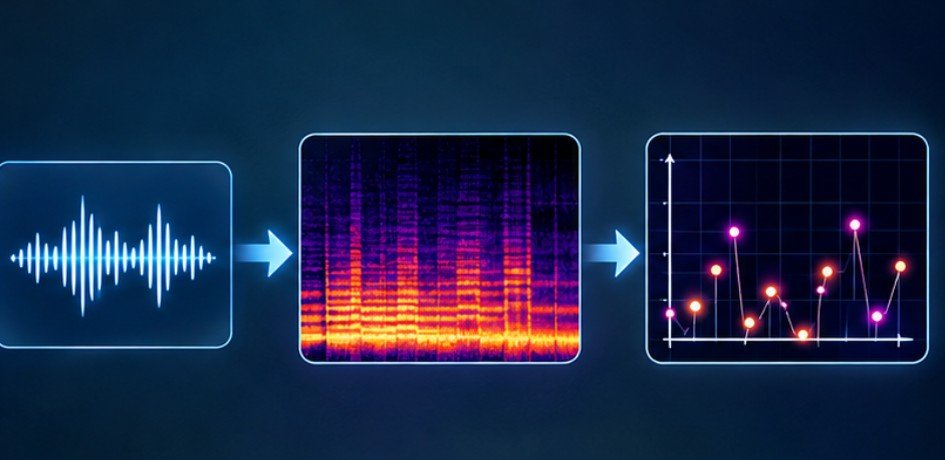
A smartphone initially receives music as a changing audio waveform.
The software analyzes short segments using a mathematical technique called the Fast Fourier Transform, or FFT.
This reveals which frequencies are present at particular moments.
Those measurements create a spectrogram, a visual representation of sound across time and frequency.
Low bass notes appear in lower-frequency regions, while cymbals and higher-pitched instruments produce activity elsewhere.
The spectrogram provides a structured way to examine otherwise complicated audio.
While music recognition systems use audio analysis to identify recordings, music visualizer apps that respond to sound use similar audio characteristics to generate dynamic visual effects that react to different frequencies and sound patterns.
Finding Distinctive Frequency Peaks
A spectrogram contains enormous amounts of information, much of which is unnecessary for recognition.
Algorithms therefore identify strong, locally prominent frequency peaks.
These peaks represent acoustic landmarks that are relatively likely to remain detectable when music is played through speakers or mixed with environmental noise.
The selected points form a sparse pattern sometimes called a constellation map.
Research presented through the International Society for Music Information Retrieval examines how modern fingerprinting systems can improve resilience against background noise, microphone differences, and room acoustics.
Creating Compact Digital Hashes
The application next connects selected frequency peaks into pairs. Each pair can encode three useful measurements: the frequencies of two peaks and the time separating them. These measurements become compact digital hashes.
Consider two recognizable acoustic events occurring 0.4 seconds apart. Their frequencies and timing relationship help form a searchable signature.
A single hash is not necessarily unique. However, numerous matching hashes arranged consistently provide much stronger evidence.
This approach dramatically reduces the amount of information needed for identification.
How Apps Match a Recording Against Millions of Songs
Once an application generates fingerprints, it searches an indexed reference database. The system does not need to compare the recorded clip against every complete audio file.
Instead, it retrieves candidate recordings associated with matching hashes.
Why Timing Determines the Correct Match
Suppose your phone records a song beginning 45 seconds into its original recording.
Matching acoustic events should occur in approximately the same sequence, with a consistent 45-second displacement.
The algorithm examines these timing relationships to distinguish genuine matches from accidental similarities.
If enough fingerprints agree at a common offset, the recording becomes a strong candidate.
The system then retrieves associated metadata, such as the song title, performer, and release information.
The open-source MusicBrainz AcoustID documentation illustrates how acoustic fingerprints can be linked to recording identities and music metadata.
Cloud Recognition vs. On-Device Song Detection
Not every music recognition application processes information in the same location.
Some depend on remote servers, while others perform identification directly on the smartphone.
Cloud-Based Recognition
Cloud recognition sends digital fingerprints or related recognition data to a remote service.
The server searches its reference catalog and returns the result.
This arrangement can support extensive music collections and database updates without requiring a large local catalog.
However, an internet connection is generally necessary to complete the search.
On-Device Recognition
On-device systems store optimized recognition data locally. Google’s Pixel Now Playing technology provides a well-known example.
In its published research, Google described an on-device fingerprint database containing more than 70,000 songs, demonstrating that useful recognition could operate without continuous internet access. That figure describes the researched system, not necessarily today’s catalog size.
Current Pixel features can also use cloud searching for recordings missing from the local database, depending on device capabilities and settings.
On-device processing can reduce network dependency, although local catalogs remain subject to storage and coverage limitations.
Beyond identifying recorded songs, digital technology is also transforming how audiences experience music, with immersive platforms exploring how virtual reality technology changes live music experiences.
Why Background Noise Does Not Always Prevent Identification
One surprising feature of audio recognition is its ability to identify music in environments that sound chaotic to human listeners.
A frequency-based fingerprint may retain enough distinctive landmarks even when conversations or other noises interfere.
However, accuracy depends heavily on the quality of the captured signal.
Common obstacles include distorted speakers, excessive crowd noise, overlapping songs, unusually short samples, and recordings absent from the reference catalog.
A study presented at the Institute of Electrical and Electronics Engineers examined audio fingerprinting for identifying live musical performances, demonstrating why alternative fingerprint representations may be needed for recordings that differ from their studio versions.
The published research highlights the distinction between identifying an exact recording and recognizing a different performance of the same composition.
A recording-based detector can identify a familiar track through noise yet fail when the artist performs it with a different arrangement.
Can Music Recognition Apps Identify Humming?

Recognizing a hummed melody is a different technical challenge. Traditional audio fingerprinting searches for features of a particular recording. Humming does not reproduce the recording’s original instruments, production, or precise timing.
Melody-recognition systems instead analyze pitch movement and musical relationships.
Machine learning can compare a hummed tune against melody representations derived from recorded songs. This allows some services to identify music even when users remember only a tune.
For example, Google’s Hum to Search feature accepts humming, singing, or whistling rather than requiring the original recording.
Nevertheless, successful identification depends on melody clarity, pitch consistency, model performance, and available reference material.
Why Song Identification Sometimes Produces Incorrect Results
Recognition systems cannot identify every recording with equal reliability.
Unreleased tracks, obscure independent recordings, remixes, and alternate performances may be missing from their catalogs.
Two songs containing identical sampled audio can also produce overlapping fingerprints.
Pitch changes, substantial speed adjustments, and heavy editing may interfere with conventional matching methods.
Developers continue exploring machine-learning-based improvements.
Research described in Audio Denoising for Robust Audio Fingerprinting investigates using learned noise reduction to preserve fingerprint quality under difficult listening conditions.
Importantly, audio recognition is not proof of musical ownership or copyright infringement. It establishes a possible recording match, not the legal rights associated with that recording.
Although identifying a recording helps establish which song is being played, it does not determine who owns its creative rights, making it important to understand how AI-generated music affects copyright ownership.
Frequently Asked Questions
1. How do music recognition apps identify songs without lyrics?
They analyze audio frequencies, timing relationships, and distinctive acoustic patterns. Those characteristics create fingerprints that can match existing recordings without requiring speech recognition or lyric transcription.
2. Can Shazam identify songs without an internet connection?
Some Shazam features can save a recognition request for later matching, but identifying an unfamiliar song generally requires a connection to its recognition service.
3. Why can’t recognition apps identify live music?
Live performances may differ significantly from studio recordings in tempo, arrangement, instrumentation, and acoustics. Traditional fingerprint matching generally works best when the reference recording closely resembles the captured audio.
4. Can a music recognition app identify an unreleased song?
Only if the relevant recording or recognizable reference material is available in its identification catalog. Otherwise, even excellent audio quality may not produce a match.
The Remarkable Mathematics Behind a Familiar Song
The next time a song catches my attention in a coffee shop, I know that my phone is doing something more precise than simply listening.
It is converting sound into mathematical landmarks, searching for matching patterns, and checking whether those patterns occur in the correct sequence.
Understanding how do music recognition apps identify songs also reveals why clear audio, sufficient recording time, and comprehensive reference catalogs matter so much.
The technology is not flawless, particularly with obscure recordings or live performances. Yet its fundamental achievement remains extraordinary: a few seconds of ordinary sound can become enough information to recover a recording’s identity.