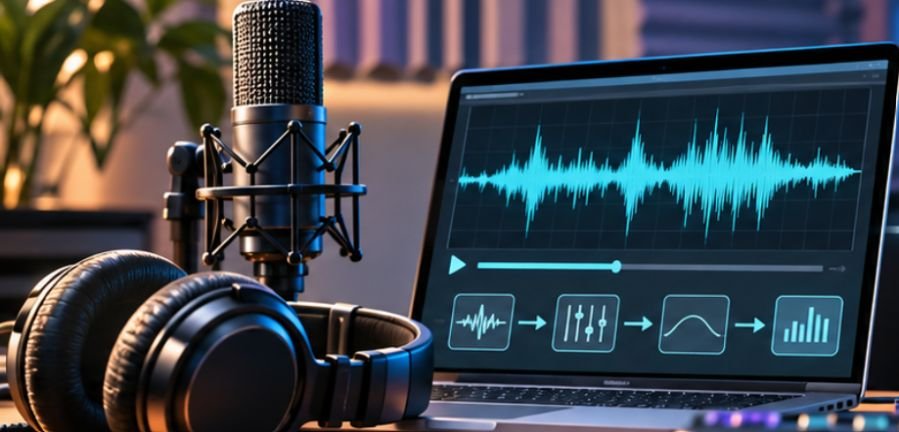
A computer can recognize musical patterns in seconds, even when a song mixes jazz harmonies with hip-hop beats or electronic production. But how does automatic music genre classification work when musical styles rarely follow strict boundaries?
The answer involves artificial intelligence, audio signal processing, and machine learning. Instead of listening like a human, classification software measures rhythm, frequency patterns, timbre, and other characteristics to identify the most likely genre.
This technology helps streaming platforms organize enormous music libraries, improves recommendation systems, and gives independent American musicians new ways to categorize their releases.
What Is Automatic Music Genre Classification?
Automatic music genre classification is the process of identifying a song’s musical style using computational analysis rather than relying entirely on human judgment.
A classification system examines audio recordings and compares their characteristics with patterns learned from previously labeled music.
For example, a recording featuring distorted guitars, aggressive percussion, and dense instrumentation might receive a rock or metal classification.
Meanwhile, tracks containing electronic synthesizers, repetitive dance rhythms, and programmed percussion may receive electronic music labels.
However, classification does not necessarily identify an artist’s intended genre. It predicts categories based on available evidence.
Research published through Stanford University’s music genre classification project demonstrates how machine learning can categorize recordings using extracted audio features.
How AI Turns Sound Into Genre Predictions
The classification process typically follows several stages, transforming an ordinary audio recording into measurable information.
Step 1: Preparing the Audio for Analysis
Before classification begins, software converts music files into a consistent digital format. Processing may include adjusting sample rates, normalizing amplitude, selecting audio channels, and removing unwanted noise when appropriate.
Next, the recording is divided into smaller sections. Short analysis frames, commonly around 10–40 milliseconds, capture rapidly changing sound characteristics. Longer segments provide information about musical structure and rhythmic patterns.
Overlapping frames help preserve transitions between sounds.
This preparation matters because analyzing an entire recording as one uninterrupted signal can obscure important details.
Step 2: Extracting Musical Characteristics
Computers cannot directly interpret musical emotion or cultural meaning from raw audio samples.
Instead, they calculate numerical features describing the recording.
Several features are particularly useful for distinguishing genres.
Audio-processing technologies also support other aspects of modern music production, including vocal tuning and pitch correction.
These tools can adjust inaccurate notes, improve vocal consistency, and refine performances during recording or post-production. Learn more about how real-time pitch correction technology works and how it modifies vocal pitch while audio is being processed.
Spectrograms and Frequency Patterns
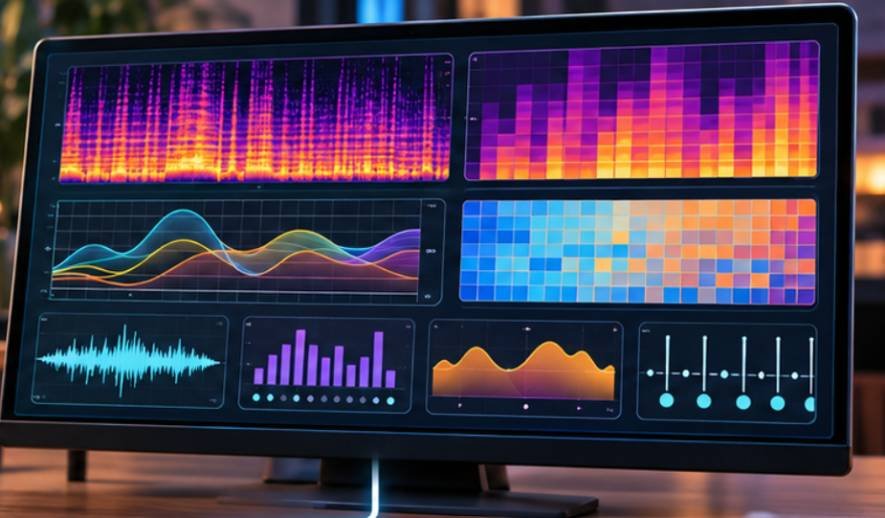
A spectrogram represents sound frequencies over time, showing how energy is distributed across different frequency bands.
Mel spectrograms transform frequency information onto a perceptually motivated scale related to human pitch perception.
These representations can expose recurring instrumental patterns, percussion activity, and differences between arrangements.
MFCCs and Instrumental Texture
Mel-Frequency Cepstral Coefficients, commonly called MFCCs, summarize the spectral characteristics of sounds.
They help describe timbre, allowing algorithms to detect differences between acoustic instruments, electronic synthesizers, and vocal textures.
However, MFCCs alone cannot reliably distinguish every genre.
Tempo, Rhythm, and Energy
Beat detection estimates rhythmic timing, while tempo analysis measures musical speed in beats per minute.
Root Mean Square (RMS) energy describes signal strength over short intervals. Onset strength can reveal the timing and intensity of musical attacks.
The librosa audio feature documentation explains how developers calculate these features using open-source audio analysis tools.
These audio-analysis techniques are also widely relevant to modern music production, where digital tools help musicians manipulate sound, refine recordings, and create complex arrangements. Explore what technology is used in modern music production to understand how DAWs, virtual instruments, audio processors, and other technologies support today’s recording workflows.
How Machine Learning Learns Musical Genres
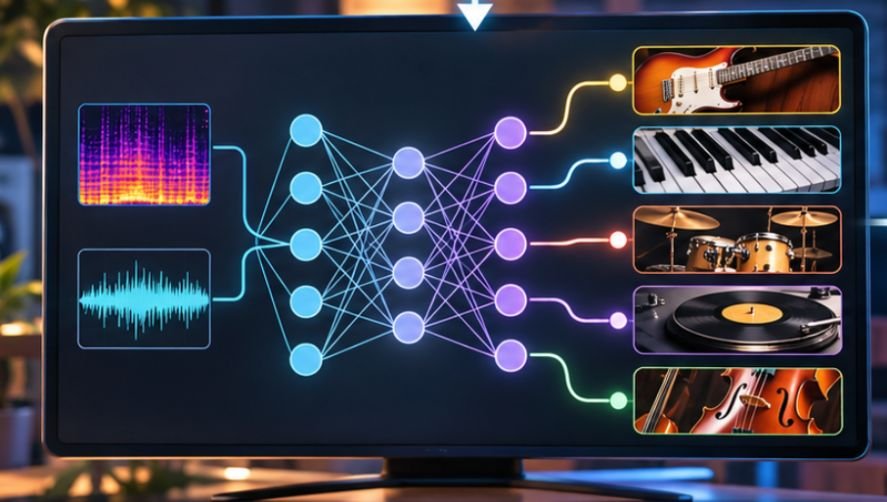
After extracting audio characteristics, classification systems use trained algorithms to identify relationships between sound patterns and genre labels.
Training usually requires a dataset containing recordings associated with known musical categories.
Traditional Machine Learning Algorithms
Several established algorithms remain useful. Support Vector Machines identify boundaries separating groups of musical features.
K-Nearest Neighbors compares an unfamiliar recording with similar examples in the training dataset.
Random forests combine multiple decision trees to produce classifications.
These methods can perform effectively when developers provide carefully selected audio features. They are also useful for projects with smaller datasets or limited computing resources.
Deep Learning and Neural Networks
Deep learning systems can discover complex patterns directly from audio representations.
Convolutional Neural Networks (CNNs) examine spectrograms to recognize localized frequency and timing relationships.
Long Short-Term Memory networks (LSTMs), including bidirectional variants, model sequential information across musical passages.
Transformers use attention mechanisms to capture relationships between different parts of a recording.
A study published in PLOS ONE research on neural networks for music genre classification examined residual-learning and dual-network approaches for improving classification performance.
The research illustrates why combining complementary audio representations can strengthen music recognition systems.
How Does Automatic Music Genre Classification Work for Mixed-Genre Songs?
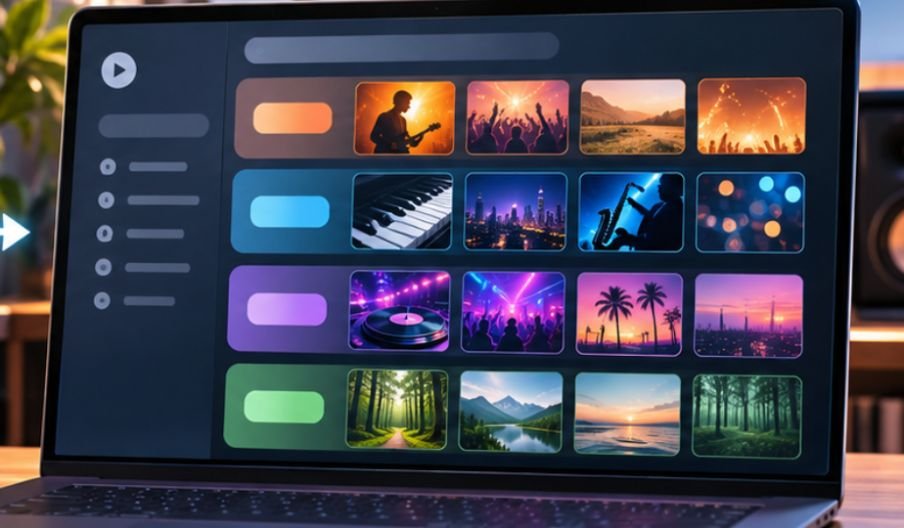
Hybrid music presents one of the biggest challenges for automated classification.
Consider a track combining country vocals, electronic percussion, and pop arrangements.
Its rhythm may resemble dance music, while its instrumentation and vocal delivery suggest another category.
A traditional classifier might assign the recording to whichever genre receives the highest prediction score.
For illustration, a model could produce:
- Pop: 45%
- Country: 35%
- Electronic: 20%
These are hypothetical model scores, not independently verified genre probabilities.
A multi-label classifier offers another approach by assigning several genre tags simultaneously.
Researchers presenting work through the International Society for Music Information Retrieval have examined how musical genres evolve and why fixed classifications may fail to capture changing artistic identities.
This becomes especially relevant for contemporary American music, where hip-hop, country, R&B, and electronic styles frequently intersect.
Where Automated Genre Recognition Makes a Difference
Genre detection supports several music-industry activities.
Streaming Libraries and Discovery
Streaming services can use musical characteristics to support catalog organization, playlist creation, and music discovery.
However, recommendation algorithms also consider listening behavior, user interactions, and other signals beyond genre.
Managing the extensive audio catalogs behind these services also requires reliable storage infrastructure, allowing music files and associated metadata to remain accessible across platforms and devices. Learn how cloud storage works for digital music libraries to understand how remote storage, synchronization, and backup systems support modern digital music collections.
Independent Artists and Music Distribution
Independent musicians can use automated tagging to review how their recordings might be categorized.
A producer releasing an experimental track could compare suggested labels before selecting appropriate distribution metadata.
Still, automated suggestions should complement artistic judgment rather than replace it.
Music Archives and Research
Large digital collections benefit from searchable genre information.
MusicBrainz, a community-maintained music database, supports genre information through its MusicBrainz genre documentation and tagging systems.
Such metadata can complement audio-based classification and improve catalog consistency.
A Practical Test for Evaluating Genre Classification
A simple evaluation can reveal whether a classifier recognizes musical styles reliably.
- Select 30 recordings representing three genres, with ten examples per category.
- Use recordings from different artists to reduce artist-specific bias.
- Divide the collection into training and testing groups, keeping artists separate.
- Extract the same audio features from every recording.
- Train a classification model and evaluate its predictions on the untouched test set.
- Review incorrect classifications and identify recurring genre confusion.
Suppose a model correctly identifies 24 of 30 test recordings.
Its accuracy would be:
\[ \frac{24}{30}\times100=80\% \]
This hypothetical result demonstrates accuracy calculation, not a benchmark for real systems.
Developers should additionally examine precision, recall, F1 scores, and confusion matrices because overall accuracy can conceal weak performance on individual genres.
For larger projects, use separate validation and test datasets.
Why Genre Recognition Still Makes Mistakes
Even sophisticated classification systems encounter significant limitations.
Overlapping musical characteristics: Multiple genres share instruments, tempos, and production techniques.
Unbalanced datasets: Models trained primarily on mainstream recordings may perform poorly on underrepresented regional styles.
Recording quality: Background noise, distortion, and inconsistent mastering can affect extracted features.
Changing musical conventions: Genre characteristics evolve alongside cultural and artistic developments.
Misleading training labels: Incorrect or inconsistent human annotations teach algorithms unreliable patterns.
Improving these systems requires diverse training recordings, consistent labeling, artist-independent testing, and periodic model evaluation.
Combining audio analysis with lyrics and reliable metadata may provide additional context, although these sources can also introduce bias.
Frequently Asked Questions
1. Can AI identify the genre of any song?
AI can predict genres for many recordings, but unusual arrangements, hybrid styles, and unfamiliar regional traditions can reduce accuracy.
2. Does genre classification require lyrics?
No. Many classifiers rely entirely on audio features. Lyrics can provide additional information when suitable text-analysis methods are available.
3. Which algorithm works best for music classification?
There is no universal winner. CNNs are effective for spectrogram analysis, while SVMs and random forests remain useful for structured audio features.
4. How accurate is automatic music genre classification?
Accuracy varies with datasets, genre definitions, model architecture, and evaluation methods. Results from different studies are not always directly comparable.
The Future of Smarter Music Classification
Music refuses to remain inside perfectly defined categories, and that is precisely what makes automated classification challenging.
The strongest systems recognize meaningful relationships between rhythm, instrumentation, recording characteristics, and musical structure without assuming every song belongs to one rigid category.
Future improvements will likely involve richer audio representations, multi-label predictions, more representative training datasets, and closer integration with human expertise.
For musicians, developers, and listeners, the practical lesson is straightforward: genre classification works best as a discovery tool, not an unquestionable authority.
A machine can identify familiar musical patterns, but understanding why music crosses cultural and creative boundaries still requires human perspective.