A chart-ready song no longer requires a million-dollar recording studio. With a capable laptop, music software, and a few essential devices, independent artists can produce recordings that compete with professional releases.
Understanding what technology is used in modern music production reveals how digital tools have transformed songwriting, recording, sound design, and distribution. Digital audio workstations, MIDI controllers, virtual instruments, artificial intelligence, and advanced recording equipment now work together throughout the creative process.
The biggest change is accessibility. Musicians can build sophisticated arrangements from bedrooms, collaborate across cities, and prepare finished tracks for major streaming platforms without traditional studio infrastructure.
Digital Audio Workstations: The Center of Modern Recording
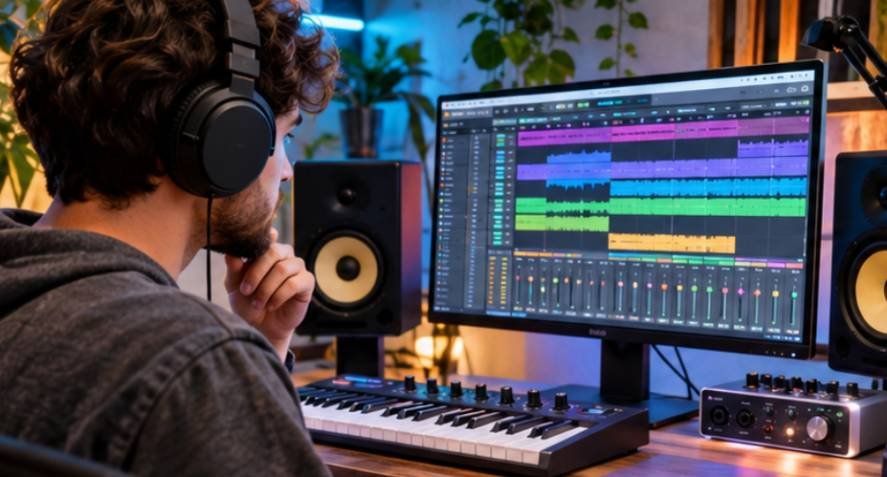
A digital audio workstation (DAW) is software that records, edits, arranges, processes, and exports music.
Popular programs include Ableton Live, FL Studio, Logic Pro, Pro Tools, and Cubase. Although their workflows differ, each provides the essential tools needed to produce complete songs.
How DAWs Shape a Song
Producers use digital workstations to combine vocal recordings, instrument performances, programmed drums, and electronic sounds into synchronized tracks.
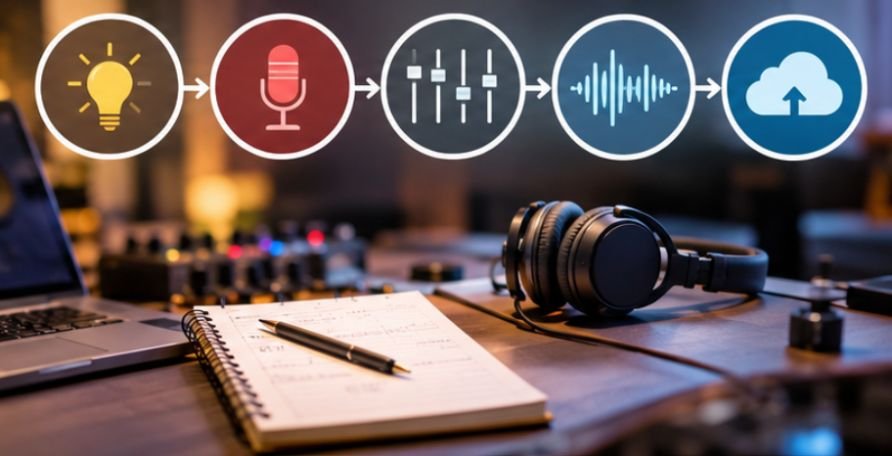
A typical production session involves recording individual parts, correcting timing, adjusting volume levels, applying effects, and exporting the finished recording.
Berklee College of Music includes DAW configuration, MIDI sequencing, virtual instruments, audio editing, and mixing in its professional music-production curriculum.
This reflects an important industry reality: mastering one production environment is generally more valuable than constantly switching between software platforms.
MIDI Technology Turns Musical Ideas Into Editable Data
Musical Instrument Digital Interface (MIDI) allows electronic instruments, controllers, and computers to exchange performance instructions.
Unlike recorded audio, MIDI contains information about notes, timing, velocity, and other controls rather than actual sound.
For example, a producer can record a piano melody using a MIDI keyboard and later replace the piano sound with strings or synthesizers without performing the melody again.
The MIDI Association explains that MIDI 2.0 expands expressive capabilities through higher-resolution controls and more detailed note-level information.
MIDI Controllers and Drum Pads
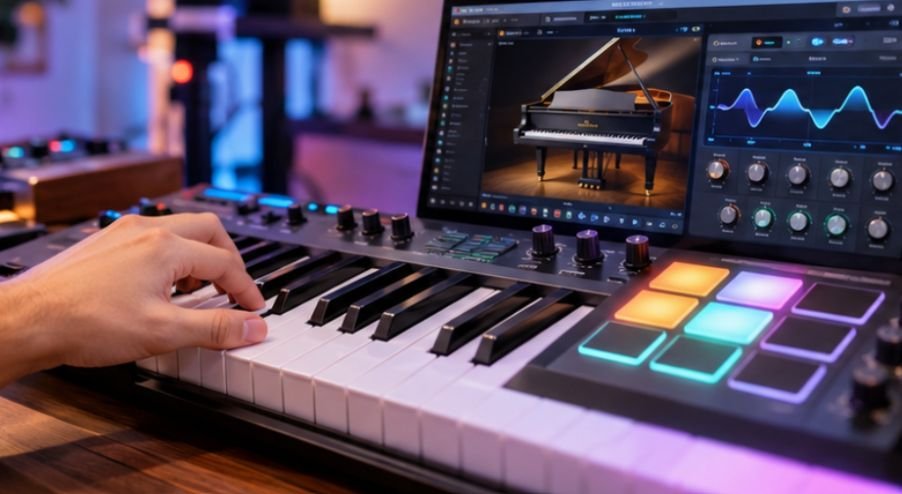
MIDI keyboards allow musicians to play virtual instruments naturally. Drum pads provide tactile control when programming percussion.
Many devices also feature knobs, faders, and transport buttons for adjusting software parameters.
These controllers are particularly valuable for electronic music, hip-hop, film scoring, and arrangements involving multiple virtual instruments.
Virtual Instruments and Plugins Expand Creative Possibilities
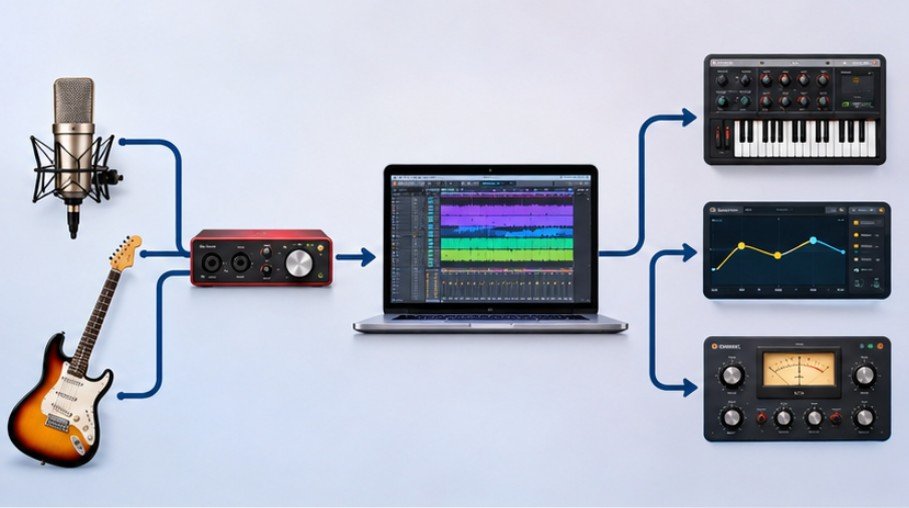
Software instruments recreate the behavior of traditional instruments or generate entirely new electronic sounds.
A producer can arrange orchestral strings, vintage synthesizers, acoustic pianos, and sampled percussion without physically owning those instruments.
Common production plugins include:
- Equalizers that balance frequencies.
- Compressors that control dynamic range.
- Reverb effects that simulate acoustic spaces.
- Delay processors that create repeating echoes.
- Pitch-correction tools that refine vocal performances.
Software synthesizers generate sound electronically, while samplers play and manipulate recorded material.
Music recognition technology uses related audio-analysis techniques to identify recordings by comparing their acoustic characteristics. Understanding how music recognition apps identify songs also offers insight into how digital systems analyze and interpret audio beyond the music production environment.
However, virtual instruments cannot automatically reproduce every expressive detail of a live performance. Realistic results depend on arrangement, articulation, dynamics, and programming.
Recording Hardware Still Determines Sound Quality
Digital software is powerful, but physical recording equipment remains essential for capturing vocals and acoustic instruments.
Audio Interfaces and Microphones
An audio interface converts analog signals from microphones or instruments into digital information a computer can process.
It also converts digital audio back into sound for headphones and studio monitors.
Condenser microphones are commonly used for detailed studio vocals, while dynamic microphones can work effectively with loud instruments and less controlled recording environments.
Proper microphone placement and room acoustics often improve recordings more noticeably than expensive software upgrades.
Computers, Storage, and Monitoring
Modern music production benefits from efficient processors, sufficient RAM, and fast solid-state drives.
Complex sessions containing numerous instruments and effects can strain limited computer resources.
Studio headphones and monitors help producers identify unwanted frequencies, distortion, and balance problems.
For beginners, accurate monitoring and a quiet recording environment should take priority over purchasing numerous plugins.
Artificial Intelligence Is Changing Creative Workflows
AI-assisted music technology can accelerate repetitive production tasks and provide new creative options.
Available applications include vocal isolation, stem separation, automatic transcription, noise reduction, sound classification, and suggested mastering adjustments.
Some generative systems can also create musical ideas or synthetic vocals.
Beyond music creation, AI also influences how listeners discover new tracks, with recommendation algorithms analyzing listening behavior and musical preferences to suggest relevant content. Exploring how artificial intelligence recommends songs on music apps highlights another important application of AI across the modern music industry.
Where AI Helps—and Where It Falls Short
AI-powered stem separation can extract approximate vocal or instrumental parts from a mixed recording. Automated mastering software can suggest tonal and dynamic adjustments.
However, these systems may introduce artifacts, misunderstand artistic intentions, or produce inconsistent results.
Copyright also requires attention. The U.S. Copyright Office has examined AI-generated material and emphasized the importance of sufficient human authorship when determining copyright eligibility.
Producers should verify licensing terms, obtain necessary permissions, and avoid unauthorized voice cloning.
AI works best as a creative assistant rather than an unquestioned replacement for musical judgment.
Sampling, Sound Design, and Digital Beat-Making
Sampling technology allows producers to incorporate recorded sounds into new compositions. These sounds might include percussion, environmental recordings, spoken audio, or fragments of existing music.
Drum machines and grooveboxes combine sequencing with hands-on controls, allowing producers to construct rhythmic patterns without traditional instrumental performances.
The Library of Congress Citizen DJ project demonstrates how historical audio collections can inspire new musical creations while emphasizing sampling permissions and ethical considerations.
Not every publicly accessible recording is free to reuse. Commercial releases may require clearance of both composition and sound-recording rights.
Cloud Collaboration Connects Different Studios
Cloud storage and online collaboration platforms allow artists, engineers, and producers to exchange session files without working in the same location.
For example, a vocalist in Atlanta can record over an instrumental created by a Los Angeles producer, while an engineer in Nashville handles the final mix.
Shared audio stems, project backups, and synchronized folders make these collaborations practical.
However, collaborators must agree on file formats, sample rates, plugin compatibility, and project versions.
Exporting consolidated WAV stems is often more reliable than assuming everyone owns identical software.
Mixing, Mastering, and Streaming Technology
Mixing combines individual recorded tracks into a balanced musical presentation.
Mastering prepares the finished mix for release, addressing tonal consistency, dynamics, technical defects, and delivery requirements.
Digital processors provide detailed control over frequency balance, stereo imaging, compression, and limiting.
The Audio Engineering Society publishes technical recommendations addressing loudness management for online streaming and on-demand distribution.
Producers should avoid excessive limiting simply to achieve higher perceived volume.
Streaming platforms commonly apply loudness normalization, making clean dynamics and musical balance more useful than maximum loudness alone.
Final masters are commonly delivered as uncompressed WAV files, while distributors handle platform-specific encoding and delivery.
Independent musicians should also understand how digital music distribution works for artists to learn how completed recordings reach streaming platforms, how release information is managed, and how their music becomes accessible to listeners worldwide.
How to Build an Affordable Home Music Studio
Understanding what technology is used in modern music production also helps beginners avoid unnecessary spending.
Start with equipment suited to the music you actually intend to create.
Essential Equipment Checklist
- Choose a reliable computer capable of running your preferred DAW.
- Install a beginner-friendly workstation with included instruments and effects.
- Purchase an audio interface if recording microphones or instruments.
- Select appropriate headphones and a microphone.
- Add a MIDI controller if keyboard performance or beat programming matters.
- Back up projects regularly using external storage or a dependable cloud service.
What Should Beginners Spend?
A practical entry-level setup may cost approximately 300–800 beyond an existing computer, depending on equipment quality and whether an interface or microphone is necessary.
Electronic producers working entirely with software can often start for less.
A useful evaluation test is to finish one short recording using only essential equipment before buying additional tools.
If recording quality is poor, examine room noise and microphone placement first. If playback stutters, increase the audio buffer size or reduce processor-intensive plugins.
These improvements are often more effective than purchasing another expensive instrument.
Frequently Asked Questions
1. What technology is used in modern music production most often?
Digital audio workstations, MIDI systems, audio interfaces, virtual instruments, microphones, and processing plugins form the foundation of most contemporary production workflows.
2. Can beginners produce professional music using a laptop?
Yes. A capable laptop and suitable DAW can produce professional-quality recordings, although recording technique, acoustic conditions, arrangement, and mixing skills remain important.
3. Is expensive studio equipment necessary?
Not always. Many electronic productions require little additional hardware. Acoustic recordings may benefit more from quality microphones, appropriate interfaces, and controlled recording spaces.
4. Will AI replace traditional music producers?
AI can automate selected tasks, but artistic direction, musical interpretation, collaboration, and production decisions still benefit significantly from human expertise.
The Future of Music Production Belongs to Creative Musicians
Modern production technology has dramatically reduced the practical barriers between a musical idea and a finished recording.
Digital workstations bring entire recording environments onto personal computers, while MIDI, virtual instruments, cloud collaboration, and AI-assisted tools expand creative possibilities.
Yet advanced technology cannot guarantee compelling music.
The most effective producers understand how their equipment supports songwriting, performance, sound quality, and emotional expression.
Rather than chasing every new production tool, focus on developing a dependable workflow and learning its capabilities thoroughly.
A memorable recording ultimately depends less on the size of the studio than on the creativity behind the sound.