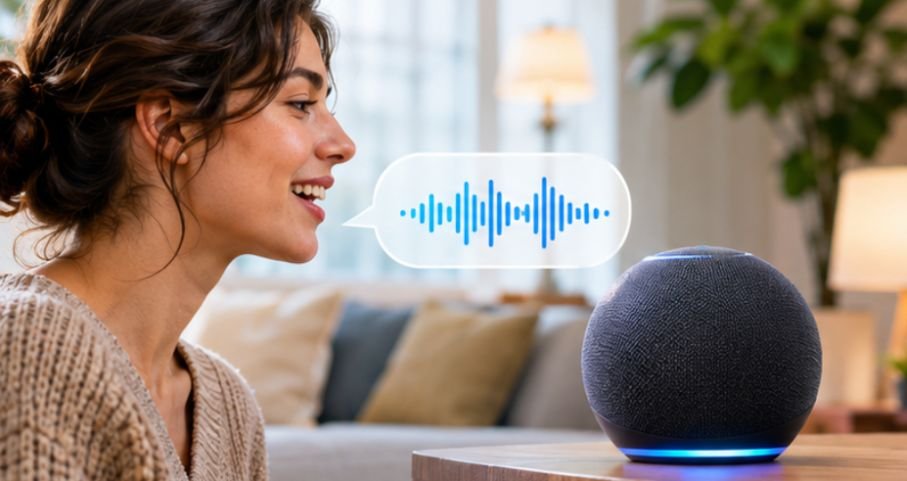
A smart speaker can identify a song request from across a noisy living room, even while music is already playing. That seemingly effortless response depends on several technologies working together.
So, how do smart speakers recognize music voice commands without confusing background conversations, television sounds, and spoken instructions?
Devices such as Amazon Echo, Google Nest, and Apple HomePod combine sensitive microphones, artificial intelligence, speech recognition, and music streaming integrations. They first detect an activation phrase, interpret the spoken request, and locate the appropriate audio.
Understanding this process explains why smart speakers occasionally misunderstand song titles, play unexpected playlists, or struggle with certain accents.
What Happens After You Ask a Smart Speaker to Play Music?
Voice-controlled music playback follows a sequence of technical operations, often completed within seconds.
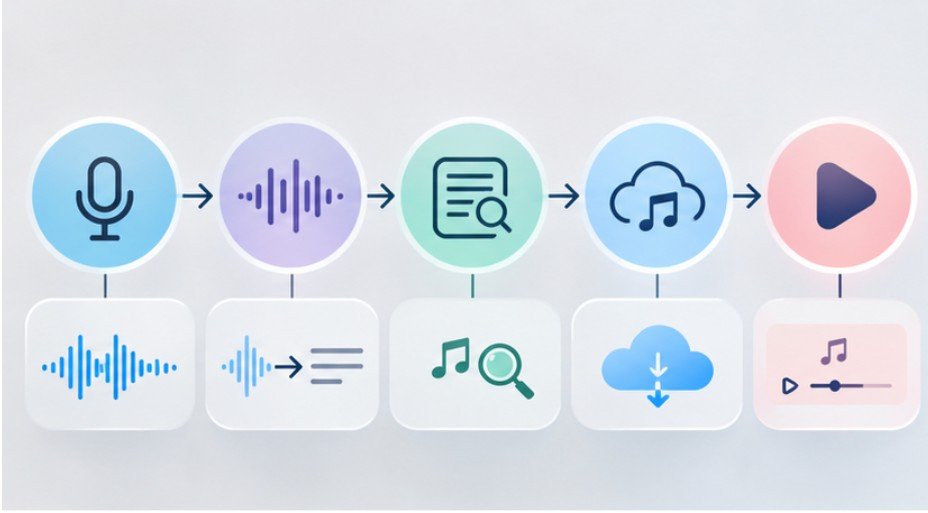
The typical process involves five stages:
- Voice detection: Microphones capture sound and identify a possible activation phrase.
- Audio processing: Software reduces background noise and improves speech clarity.
- Speech recognition: AI converts spoken words into text or another machine-readable representation.
- Intent identification: Language-processing systems determine which song, artist, playlist, or action you requested.
- Music playback: The assistant searches an available music service and starts playing the selected audio.
For example, saying “Alexa, play jazz music for dinner” triggers more than a simple keyword search.
The assistant must recognize the wake word, identify jazz as a musical genre, interpret the listening context, and choose music available through the connected service.
Once the requested music is selected, digital audio systems handle the playback of recorded tracks through different processing stages. Understanding how digital audio workstations process music recordings provides further insight into how audio tracks are recorded, edited, mixed, and prepared for playback across modern listening devices.
How Smart Speakers Hear Voices Across a Room
Multiple Microphones Capture Sound From Different Directions
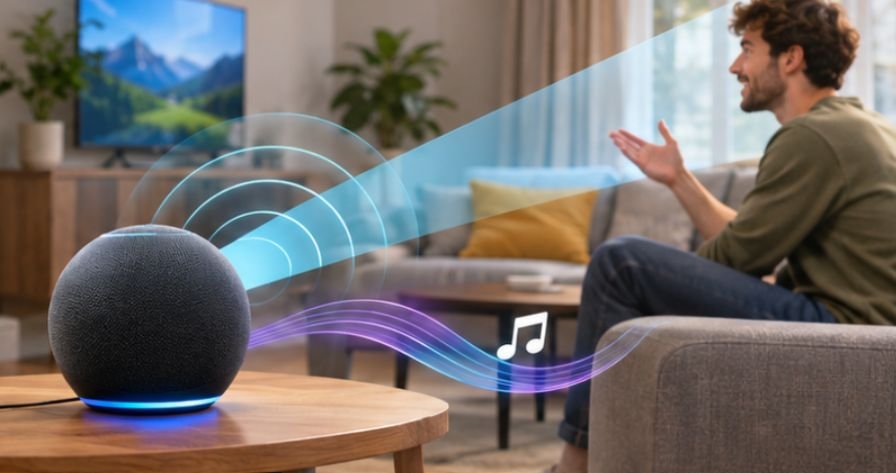
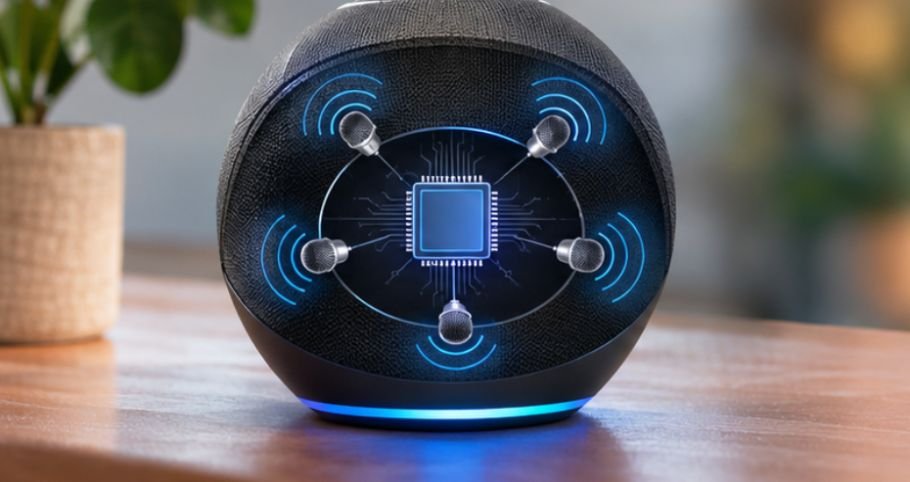
Unlike traditional microphones, many smart speakers contain microphone arrays that collect sound from several positions.
These microphones help determine where a voice originates and improve speech clarity.
Researchers at the University of Washington described how smart-speaker microphone arrays support distant interactions through beamforming, noise reduction, and acoustic echo cancellation.
Beamforming combines microphone signals to emphasize sound arriving from a particular direction.
Consequently, a speaker positioned near a television may still recognize a person speaking from the opposite side of the room.
Noise Reduction Separates Speech From Music
Smart speakers frequently receive commands while playing audio through their own speakers.
Acoustic echo cancellation helps remove the device’s playback signal from microphone input. Noise suppression further reduces unwanted sounds.
Research available through the Massachusetts Institute of Technology explains how microphone arrays and beamforming can improve captured speech in challenging acoustic environments.
However, competing voices, loud television programs, and highly reflective rooms can still reduce recognition accuracy.
Why Wake Words Matter More Than You Think
Smart speakers generally use a local wake-word detector to recognize activation phrases such as “Alexa,” “Hey Google,” or “Siri.”
A compact machine-learning model compares incoming audio patterns against characteristics associated with the activation phrase.
For many devices, this initial check takes place locally rather than requiring every sound to be uploaded for cloud analysis.
Once the device detects a likely wake word, it activates the broader voice-processing system.
Can Smart Speakers Activate Accidentally?
Yes. A television character, conversation, or similar-sounding phrase can occasionally cause unintended activation.
Research discussed by the Association for Computing Machinery examines security challenges involving voice commands originating from nearby electronic devices.
False activations matter because the speaker may temporarily treat unrelated speech as an instruction.
Wake-word detection is therefore both a convenience feature and an important privacy boundary.
How Artificial Intelligence Understands Music Requests
Recognizing spoken words is different from understanding what those words mean. Smart speakers use two related technologies to handle these tasks.
Automatic Speech Recognition Converts Audio Into Words
Automatic speech recognition, or ASR, analyzes patterns in recorded audio to identify spoken language.
Modern systems commonly use neural networks trained on large speech datasets.
Rather than matching every spoken sound against a rigid dictionary, these models estimate likely words based on acoustic information and linguistic context.
For instance, a request for “play acoustic country songs” must be interpreted despite differences in pronunciation, speaking speed, and background noise.
The National Institute of Standards and Technology identifies automatic speech recognition as a foundational speech-processing technology.
Natural Language Understanding Identifies Your Intention
Natural language understanding, or NLU, determines what action a user wants performed.
Consider three requests:
- “Play Taylor Swift” identifies an artist.
- “Play relaxing piano music” identifies a musical style or mood.
- “Skip this song” identifies a playback-control action.
Although the sentences differ, the assistant translates each into structured instructions.
Some newer voice assistants also use large language models to interpret more conversational requests, although capabilities vary by platform.
How Smart Speakers Find the Right Song
After identifying your request, the assistant must connect it with a music catalog.
Popular ecosystems support services such as Spotify, Apple Music, Amazon Music, and YouTube Music, although compatibility varies by device.
The assistant may consider the requested artist, track title, album, playlist, genre, and preferred streaming service.
An exact song request typically involves catalog matching. A broader request, such as “play upbeat workout music,” may involve playlist selection or music recommendation algorithms.
Why Do Speakers Sometimes Play the Wrong Track?
Several factors can cause unexpected results.
Similar song titles, ambiguous artist names, incomplete catalogs, regional licensing restrictions, and incorrectly configured default services can affect playback.
Subscription limitations may also prevent exact on-demand song selection.
Importantly, recognizing a music command does not mean the device has identified music already playing nearby. That is a separate task involving audio recognition technologies.
Beyond voice recognition, artificial intelligence can also analyze musical characteristics to identify genres automatically. These systems examine audio features such as rhythm, tempo, frequency patterns, and instrumentation to categorize recordings. Learn more about how automatic music genre classification works and how machine learning helps organize and identify music based on its sound.
Local Processing vs. Cloud Recognition
Not every smart speaker processes voice instructions the same way.
Local processing usually handles wake-word detection and may support selected basic commands. Cloud processing commonly provides more computationally demanding speech interpretation, catalog searches, and streaming integrations.
Some devices perform additional speech recognition directly on the hardware, reducing dependence on remote servers for supported tasks.
Cloud-based systems generally require an internet connection, while certain local functions may remain available offline.
Cloud connectivity also enables music-related activities beyond voice-controlled playback, including real-time interaction between musicians working from different locations. These connected workflows rely on online audio services and communication technologies. Exploring how online music collaboration platforms work provides further insight into how internet-based systems support shared music production and collaboration.
Users should examine individual product specifications rather than assume every speaker offers identical offline capabilities.
A Practical Test to Improve Music Voice Recognition
If your speaker regularly misunderstands commands, a controlled test can reveal the likely problem.
Try This Five-Step Listening Test
- Reduce background noise. Pause television playback and issue a simple music command.
- Change your position. Repeat the instruction from different locations around the room.
- Compare command phrasing. Try a precise title and artist instead of a vague request.
- Check your music account. Confirm the preferred streaming service is connected and supported.
- Repeat at normal volume. Speak naturally rather than shouting or exaggerating pronunciation.
If recognition improves in quieter conditions, acoustic interference may be responsible.
If the assistant understands commands but selects incorrect tracks, investigate catalog availability, music-service settings, and request wording.
Also update the speaker’s software and avoid placing it directly beside loud televisions or soundbars.
What Smart Speaker Owners Should Know About Privacy
Voice assistants typically monitor microphone input for activation phrases, but that does not necessarily mean continuous cloud recording.
Processing and retention practices differ between manufacturers and device settings.
The Federal Trade Commission recommends reviewing voice recording settings, examining privacy policies, and using microphone-disabling controls when appropriate.
Users should also inspect voice history options, recording deletion controls, and account permissions.
A hardware microphone mute switch can provide additional control, although its implementation depends on the device.
Frequently Asked Questions
1. How do smart speakers recognize music voice commands accurately?
They combine microphone arrays, wake-word detection, speech recognition, and language understanding to interpret instructions before searching a connected music service.
2. Can smart speakers recognize music commands without Wi-Fi?
Some devices support limited local voice functions, but cloud-dependent recognition and online music streaming generally require internet connectivity.
3. Why does Alexa misunderstand certain song names?
Unusual pronunciation, similar artist names, surrounding noise, and ambiguous titles can interfere with speech recognition or catalog matching.
4. Do smart speakers record every conversation?
Typically, devices process audio locally while checking for activation phrases. However, false activations and different recording policies mean users should review privacy settings carefully.
The Real Intelligence Behind Voice-Controlled Music
The remarkable feature of smart speakers is not simply that they hear instructions. It is their ability to connect acoustic signals with language, personal preferences, and enormous music catalogs.
A single request involves sound processing, machine learning, language interpretation, and digital music delivery.
Still, accurate recognition depends on microphone placement, network connectivity, subscription access, and clearly expressed commands.
For the best experience, keep your speaker updated, connect your preferred streaming platform, minimize surrounding noise, and review its privacy settings.
The technology may appear effortless, but understanding its limitations makes everyday listening considerably more reliable.