
The first time I saw a royalty statement from a track I wrote, produced, and sang on, I realized half my money was missing. That painful audit taught me why master recording ownership vs publishing rights explained for musicians is the single most profitable lesson in the music business.
Every recorded song contains two completely separate copyrights under law. One covers the specific audio file you press play on, while the other protects the underlying song written on paper.
If you only collect from your digital distributor, you are leaving half of your catalog’s income sitting in unclaimed holding accounts.
The Two-Copyright Rule Every Recording Artist Must Know
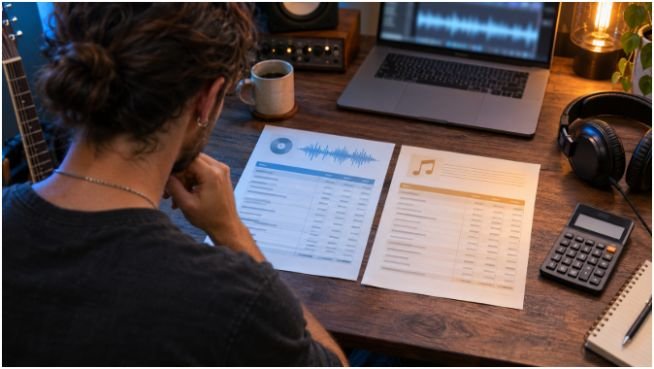
According to the U.S. Copyright Office (Circular 56A), registering a sound recording does not protect the underlying lyrics or melody, and registering a composition does not protect your recorded performance.
Think of the musical composition (publishing) as the architectural blueprint of a house. The sound recording (master) is the physical house built from that blueprint.
A hundred different builders can construct houses from that same blueprint, creating a hundred different masters. Yet the original architect still owns the blueprint every single time.
Master Recording Rights vs. Publishing Rights Side-by-Side
| Feature | Master Recording Rights | Publishing Rights (Composition) |
| What It Protects | The specific sound recording (WAV, MP3, vinyl, or CD audio). | The underlying lyrics, melody, chord progression, and sheet music. |
| Original Owner | Whoever funded and captured the recording (artist, producer, or label). | The songwriter(s) and composer(s) who created the music and lyrics. |
| Multiple Versions | Every remix, live cut, or re-recording creates a brand-new master. | Stays the exact same copyright regardless of how many artists cover it. |
| Primary Income | Interactive streaming payouts, downloads, physical sales, and master sync fees. | Performance royalties, mechanical royalties, print rights, and sync fees. |
| Main Collectors | Digital distributors, record labels, and neighboring rights societies. | Performance Rights Organizations (PROs), mechanical agencies, and publishers. |
How Both Rights Generate Royalties From a Single Track
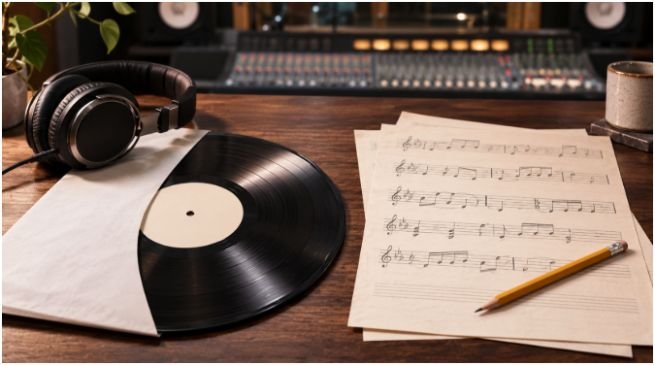
Because two distinct copyrights exist inside one audio file, a single stream or radio spin triggers two separate payment pipelines. Understanding both pipelines ensures your metadata routes every cent back to your bank account.
Master Royalties and Neighboring Rights
Your digital distributor (like DistroKid, TuneCore, or CD Baby) only collects interactive streaming payouts from platforms like Spotify and Apple Music. They do not collect public performance royalties for your master recording.
Outside the United States, master performance payouts are called neighboring rights. Whenever your recording plays on satellite radio, terrestrial AM/FM broadcasts abroad, or inside retail stores and restaurants, the master owner and featured performers earn money.
In the U.S., you must register directly with SoundExchange to collect non-interactive digital radio royalties from services like Pandora and SiriusXM. In the UK, PPL handles this collection, while societies like PPL India and RMPL license master performances locally.
Publishing Royalties: Writer’s Share vs. Publisher’s Share
Publishing income splits into two main buckets: performance royalties and mechanical royalties.
- Performance Royalties: Earned whenever your song is broadcast on radio, played on TV, performed at live venues, or streamed online. Performing Rights Organizations (PROs) like ASCAP, BMI, PRS, or IPRS collect these fees.
- Mechanical Royalties: Earned whenever your composition is reproduced—including interactive streams, digital downloads, and vinyl pressings. In the U.S., The Mechanical Licensing Collective (The MLC) collects digital audio mechanicals directly from streaming services.
Here is the trap that catches most independent songwriters: PROs divide performance royalties 50/50 between the writer’s share and the publisher’s share. If you only register as a songwriter and skip registering a publishing entity (or using a publishing administrator like Songtrust), your publisher’s share can sit uncollected.
A Worked Example: Following the Money on a $10,000 Sync Placement

Nothing clarifies the difference between these two rights faster than landing a commercial sync deal. When a music supervisor wants your song for a TV show or video game, they legally need two separate contracts: a Master Use License and a Synchronization License.
Suppose a streaming series offers $10,000 all-in (“most favored nations” split) to use your track in an episode:
- $5,000 Master Use Fee: Paid to the master recording owner. If you recorded the track independently without a label, you pocket 100% of this $5,000.
- $5,000 Sync Fee: Paid to the publishing owner(s). If you wrote the song 50/50 with a co-writer, you receive $2,500 and your co-writer receives $2,500.
- Backend Broadcast Royalties: Months later, when the episode airs globally, your PRO pays out additional performance royalties to the songwriters and publishers—even though the master side gets zero backend from U.S. TV broadcasts.
Independent artists who own 100% of both rights are called “one-stop” cleared. Music supervisors love one-stop tracks because they can clear both sides with a single email.
Real-World Scenarios That Trip Up Independent Musicians
Knowing the definitions is easy, but applying them during studio sessions and contract negotiations is where careers are made or broken.
Releasing Cover Songs Without Losing Your Master Control
If you record a cover of an Ed Sheeran hit, you own 100% of the master recording rights to your specific performance. Your distributor pays you all the master streaming revenue from your version.
However, you own 0% of the publishing rights. Ed Sheeran and his co-writers collect all the mechanical and performance royalties generated by your cover.
Locking Down Split Sheets With Producers and Co-Writers
Never upload a collaboration to a distributor before signing a one-page split sheet. Under copyright law, anyone who contributes to the lyrics or melody owns an equal share of the publishing unless a written agreement says otherwise.
Be equally clear about the master side. Many beatmakers lease non-exclusive master rights while retaining underlying ownership, whereas custom production agreements might split the master 50/50 or operate as a flat-fee work-for-hire.
Negotiating Deals Without Giving Away Both Halves
Record labels and publishing companies operate on completely different business models. If you plan to start an independent record label on a small budget, your primary asset is building a catalog of master recordings while letting songwriters keep their publishing.
Conversely, if a publishing company offers you an advance, scrutinize the clauses to negotiate in a music publishing contract so you never accidentally sign away master ownership or accept a perpetual rights grab.
Stop Leaving Half Your Catalog on the Table
Owning your masters gives you control over your recordings, while controlling your publishing guarantees long-term passive income every time your song is played, covered, or broadcast.
Open a spreadsheet today and audit your last three releases across four checkpoints: your digital distributor, your PRO (both writer and publisher accounts), The MLC, and SoundExchange. If even one of those boxes is unchecked, spend thirty minutes registering your catalog before you release your next single.
Frequently Asked Questions
1. Can an independent musician own both master and publishing rights?
Yes, if you write the song and fund the recording yourself, you automatically own 100% of both copyrights from the moment you fix the audio.
2. Do producers get publishing rights or master rights?
Producers typically negotiate a percentage of master royalties (points) and receive publishing splits only if they co-wrote the melody, chords, or lyrics.
3. Does DistroKid or TuneCore collect my publishing royalties?
Standard distribution plans only collect master recording royalties; you must join a PRO and a mechanical agency (or opt into a separate publishing admin tier) to collect publishing.
4. Which copyright is worth more: master rights or publishing rights?
Master rights generate higher immediate payouts from streaming, while publishing rights often hold steadier long-term value through radio, live venues, and cover versions.