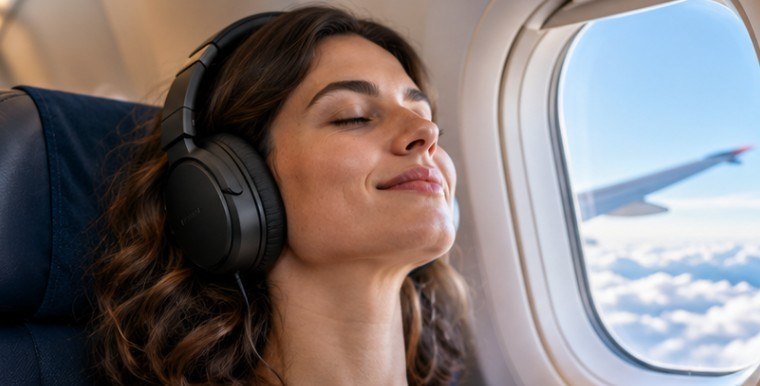
Imagine sitting on a crowded airplane, surrounded by roaring engines, conversations, and rattling luggage. You put on your headphones, activate noise cancellation, and suddenly, the constant engine noise fades into the background. The aircraft hasn’t become quieter. Your headphones have changed what reaches your ears.
So, how does noise cancellation technology work in headphones? The answer involves microphones, sound waves, and powerful digital processors working together to reduce unwanted noise.
This technology has transformed everyday listening, helping travelers, commuters, students, and remote workers enjoy clearer audio without constantly increasing the volume.
The Science That Makes Background Noise Disappear
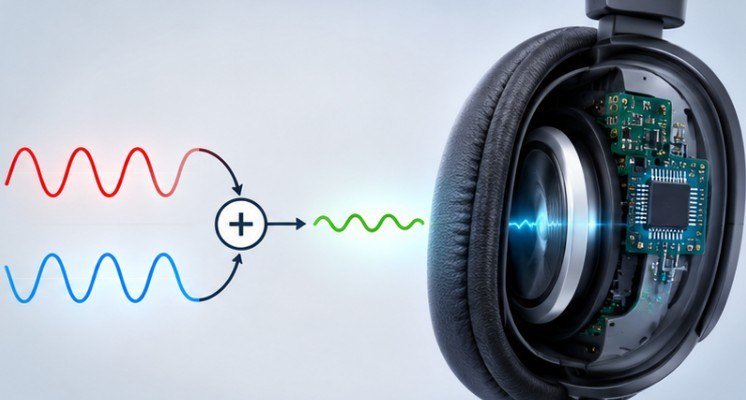
Active Noise Cancellation (ANC) works by generating sound waves designed to counteract unwanted environmental noise.
Sound travels through the air as pressure variations. Every sound wave has a frequency, amplitude, and phase that determine how it behaves.
When two waves with similar amplitudes meet at opposite phases, they interfere destructively, reducing the resulting sound pressure. This phenomenon is called destructive interference.
Researchers and educators at the University of Southern California explain how noise-canceling headphones use this principle to reduce sound reaching the listener.
How Headphones Create Anti-Noise
The entire process happens continuously while noise cancellation is active.
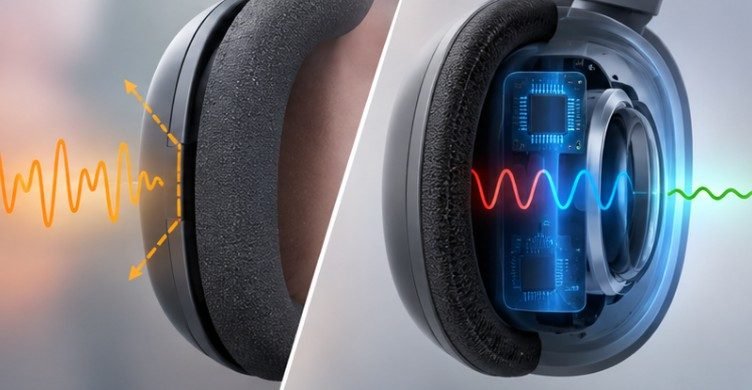
- Built-in microphones detect environmental sounds, including engine vibrations, ventilation systems, and traffic.
- A digital signal processor analyzes the captured audio and calculates a corrective waveform.
- The headphone speakers reproduce this anti-noise alongside your music or other audio.
- The anti-noise combines with incoming environmental sound, reducing unwanted pressure variations near your eardrum.
The timing must be extremely precise. Even small delays or phase errors can reduce cancellation effectiveness.
Modern processors repeatedly adjust their output to respond to changing acoustic conditions.
Active Noise Cancellation vs. Passive Noise Isolation
Although manufacturers frequently advertise noise cancellation as one feature, headphones generally reduce external sound through two different mechanisms.
Passive Isolation Creates a Physical Barrier
Passive noise isolation relies on ear cushions, earcup construction, and silicone or foam ear tips. A secure seal limits sound entering your ears, particularly at higher frequencies.
Over-ear headphones use padded earcups, while in-ear models depend heavily on properly fitted ear tips. Passive isolation requires no electrical power and continues functioning when the headphones are switched off.
Active Cancellation Targets Persistent Background Sounds
ANC uses microphones, electronics, and speakers to reduce unwanted sound electronically.
It performs particularly well against predictable, low-frequency noise, including:
- Airplane engine rumbling
- Air-conditioning systems
- Train and bus vibrations
- Continuous machinery sounds
- Low-frequency road noise
However, conversations, barking dogs, and sudden impacts are harder to suppress completely.
The most effective headphones combine good physical isolation with electronic cancellation rather than relying exclusively on either technology.
Four Noise Cancellation Systems Explained
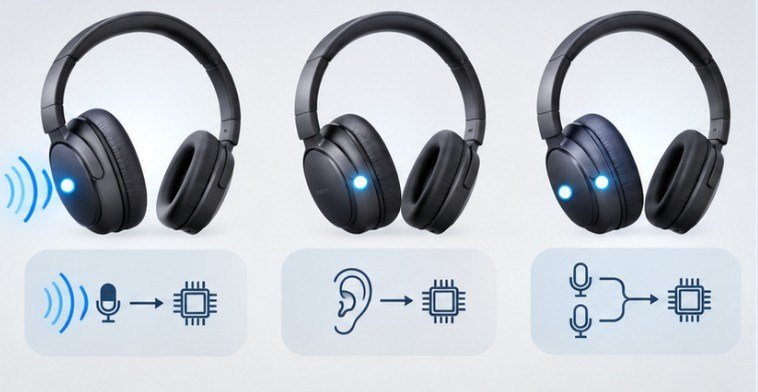
Not every noise-canceling headphone uses the same microphone arrangement.
1. Feedforward ANC
Feedforward systems position microphones outside the earcup or earbud. These microphones detect environmental noise before it enters the listening space, allowing the processor to calculate a corrective signal.
However, their performance can suffer when wind strikes the microphones or the headphone fit changes unexpectedly.
2. Feedback ANC
Feedback systems place microphones inside the earcup, closer to the listener’s ear. These microphones measure the combined sound near the ear and help the processor correct unwanted noise.
This arrangement can compensate for certain acoustic changes but requires careful control to prevent unwanted feedback or distortion.
3. Hybrid ANC
Hybrid systems combine internal and external microphones. The processor receives information from both locations, allowing it to respond to incoming noise while monitoring cancellation performance.
Hybrid designs can offer broader, more consistent noise reduction, although results still depend on the headphone’s engineering.
4. Adaptive ANC
Adaptive noise cancellation automatically modifies processing settings in response to changing environments.
For example, compatible headphones might adjust their behavior when you move from a quiet office into a busy subway station.
Some models also offer transparency modes that intentionally reproduce surrounding sounds when environmental awareness matters.
Why Some Sounds Remain Audible
One common misunderstanding is that noise-canceling headphones should eliminate every external sound. In practice, ANC has physical and computational limitations.
Low-frequency sounds are comparatively easier to predict because their waveforms change more slowly. Higher-frequency sounds require increasingly accurate timing and positioning.
Sudden noises also give the processor less opportunity to respond effectively. The physics becomes clearer through the University of Central Florida’s explanation of sound-wave interference, which illustrates how opposing waves can reduce one another.
A poor ear seal further weakens performance because external sound can leak around the headphone cushions.
This explains why expensive headphones sometimes perform worse than expected when worn incorrectly.
Are Noise-Canceling Headphones Better for Hearing Health?
Noise cancellation can encourage healthier listening habits by reducing the need to overpower environmental noise.
TheWorld Health Organization’s safe-listening guidance recommends well-fitting, noise-canceling headphones as one way to avoid unnecessarily high listening volumes.
However, ANC does not automatically make loud music safe. Listening volume and exposure duration still determine potential hearing risks.
Noise Cancellation Is Not Certified Hearing Protection
Consumer ANC headphones should not automatically replace protective earmuffs or earplugs in hazardous environments.
The CDC’s National Institute for Occupational Safety and Health explains that noise-canceling headphones should not be considered hearing protection unless they carry an appropriate Noise Reduction Rating.
For construction equipment, industrial machinery, and other hazardous noise sources, properly rated hearing protection remains essential.
How to Test Noise Cancellation Before Buying
You don’t need laboratory equipment to evaluate a headphone’s everyday performance.
Try this simple comparison:
- Play steady background noise, such as a fan or air conditioner.
- Wear the headphones without playing music.
- Listen with ANC switched off, then activate it.
- Compare how much low-frequency sound disappears.
- Repeat the test with nearby speech and intermittent sounds.
- Adjust the ear cushions or ear tips and check whether performance improves.
Test both ears carefully, especially with earbuds.
If cancellation changes dramatically when you reposition an earbud, the original seal may have been inadequate.
For frequent travelers, prioritize effective low-frequency reduction. Office workers may benefit more from comfort, voice clarity, and convenient transparency controls.
Battery Life, Comfort, and Maintenance
Active noise cancellation requires electrical power because microphones and processors operate continuously. Consequently, enabling ANC often reduces battery life compared with listening without it. Headphone battery performance also varies with volume, Bluetooth settings, and environmental conditions.
Some listeners experience a sensation of pressure when ANC is enabled. This sensation does not necessarily indicate an actual change in air pressure; altered low-frequency sound perception can contribute to the experience. Regular maintenance also matters.
Keep microphone openings clear, clean removable ear tips according to manufacturer instructions, and replace worn cushions that no longer seal properly.
The American Speech-Language-Hearing Association also encourages lower listening volumes and noise-canceling equipment to reduce excessive sound exposure.
Frequently Asked Questions
1. How does noise cancellation technology work in headphones without music?
ANC operates independently of music playback. Microphones detect environmental noise, while processors and speakers generate corrective sound waves to reduce unwanted background sound.
2. Can noise-canceling headphones block human voices?
They can reduce some speech frequencies, especially alongside effective passive isolation. However, unpredictable speech patterns make complete voice cancellation difficult.
3. Does noise cancellation drain headphone batteries?
Yes. Operating microphones and digital processors requires additional energy, although the battery impact varies between headphone models.
4. Is ANC better in over-ear headphones or earbuds?
Both can perform effectively. Over-ear designs offer substantial physical coverage, while properly fitted earbuds can provide excellent isolation and electronic cancellation.
Quieter Experience Starts With Smarter Listening
The most impressive part of noise cancellation isn’t that headphones produce silence. It’s that they use carefully controlled sound to reduce other sounds.
Understanding how does noise cancellation technology work in headphones makes it easier to choose equipment that genuinely matches your daily routine.
For airplane journeys, concentrate on low-frequency noise reduction. For commuting, consider comfort and awareness features. For long listening sessions, prioritize a secure fit and moderate volume.
Ultimately, the best noise-canceling headphones aren’t necessarily those that make the world seem completely silent. They’re the ones that help you hear what matters without turning everything else up.