Every musician has heard the same advice at some point: “Just keep creating.” While that sounds encouraging, it doesn’t explain how ideas actually turn into music. Sitting in front of a piano, guitar, or computer with a blank project can feel overwhelming, especially if you’ve never composed before.
The good news is that composing isn’t reserved for people born with extraordinary talent. It’s a skill that grows through experimentation, repetition, and curiosity. Once you stop chasing perfection and start exploring small musical ideas, learning how to compose music becomes much more approachable.
Stop Waiting for the Perfect Idea

Many beginners believe inspiration comes first, and the music follows. In reality, experienced composers often work the other way around. They create regularly, even when inspiration isn’t obvious, because they know creativity usually appears during the process rather than before it.
Instead of waiting for the perfect melody, give yourself a small challenge. Limit your time, choose a mood, or write with only a few notes. These creative constraints remove the pressure of writing something remarkable and encourage you to focus on making progress instead.
Build Your Composition Around One Strong Musical Idea
A complete song doesn’t appear all at once. It usually grows from one memorable musical idea that gradually expands into a full composition.
Start With Rhythm Instead of Melody
One effective technique is to loop a simple drum groove. Rather than searching for chords immediately, experiment with a rhythmic bassline or hum a melody that naturally fits the beat. Once the groove feels comfortable, begin layering harmony and additional instruments.
This rhythm-first approach helps beginners develop musical flow before worrying about more complex music theory.
Challenge Yourself With Three Notes
Limiting yourself to just three notes may sound restrictive, but it forces creativity in surprising ways. Experiment with different rhythms, pauses, dynamics, and phrasing before introducing another note.
You’ll quickly discover that memorable melodies often rely more on rhythm and repetition than on a wide range of pitches.
Let a Scene Guide Your Music
Instead of thinking about scales or chord progressions, imagine a specific scene.
Picture a quiet beach at sunset, a crowded city during a rainstorm, or someone running through a foggy forest. Now compose a short musical idea that matches that atmosphere.
This exercise shifts your attention toward emotion, which often creates more engaging music than technical perfection alone.
Learn Just Enough Music Theory to Support Your Creativity
Music theory should make composing easier, not more intimidating.
Understanding chord progressions, rhythm, harmony, and song structure gives you tools to organize your ideas without limiting your creativity. You don’t need to master advanced theory before writing your first song.
As your confidence grows, concepts like key signatures, modulation, and voice leading will naturally become easier to understand because you’ll already have practical experience applying them.
If you’re also exploring songwriting, understanding what is a refrain in music can help you create memorable sections that listeners recognize and remember throughout a composition.
Try Working Backward
Most beginners naturally start at the beginning of a song.
Another approach is to write the ending first.
Compose the emotional climax, final chorus, or last chord progression before anything else. Once you know where your music is heading, building the journey becomes much easier because every section has a clear destination.
Many film composers use this technique to ensure the emotional payoff feels intentional.
Learn From Music You Love Without Copying It
Every composer learns by studying other music.
Choose a song you enjoy and learn its melody on your instrument. Then begin experimenting.
- Slow the tempo.
- Change the rhythm.
- Replace major chords with minor chords.
- Rearrange the instrumentation.
- Alter the time signature.
These changes help you understand why certain musical ideas work while encouraging you to create something original instead of imitating another artist.
The goal isn’t to copy the composition. It’s to recognize techniques you can adapt into your own creative process.
Technology Makes Learning Easier
Modern tools have removed many traditional barriers to music composition.
Digital Audio Workstations (DAWs)
Programs such as GarageBand, BandLab, and Ableton Live allow beginners to record, edit, arrange, and experiment with music even if they cannot read traditional notation. Features like MIDI editing, virtual instruments, and loop libraries make it easy to explore different musical ideas.
Music Notation Software
If you prefer writing music on a staff, programs like MuseScore provide a straightforward way to create sheet music while instantly playing your composition back. Hearing your ideas immediately makes revision much more productive.
Technology won’t replace creativity, but it gives beginners more opportunities to experiment, refine ideas, and complete songs.
The Best Way to Improve Is to Finish More Music
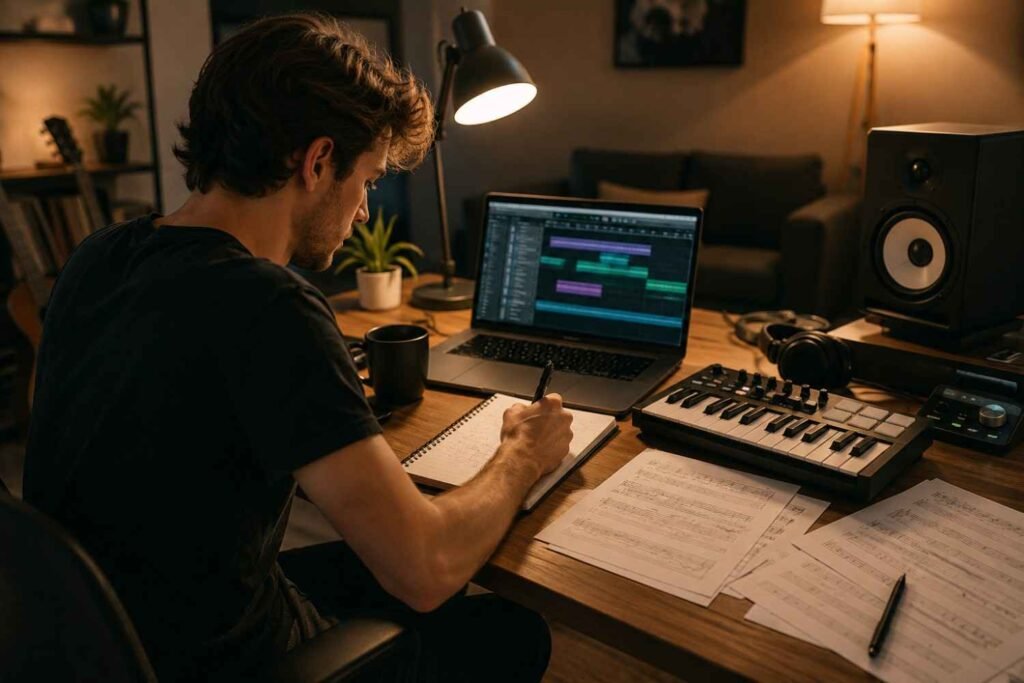
Many aspiring composers spend weeks polishing the first sixteen bars of a song without ever completing it.
Finished compositions teach lessons that unfinished sketches never can. Every completed project improves your understanding of arrangement, transitions, pacing, dynamics, and musical storytelling.
Not every piece needs to become your masterpiece. Some songs exist simply to teach you something new.
The more music you finish, the more naturally your creative voice begins to emerge.
FAQs: Creative Ways to Learn How to Compose Music from Scratch
1. Can I learn how to compose music without reading sheet music?
Yes. Many beginners start with DAWs, ear training, and experimentation before learning formal notation.
2. Should I learn music theory before composing?
No. Basic theory is helpful, but composing alongside learning theory often leads to faster improvement.
3. What software is best for beginner composers?
GarageBand, BandLab, Ableton Live, and MuseScore are popular beginner-friendly options for recording and composing.
4. How often should I practice composing?
Short, consistent sessions several times a week usually produce better results than occasional long sessions.
The Songs You Finish Teach You More Than the Ones You Imagine
Learning how to compose music isn’t about waiting for extraordinary inspiration or mastering every rule before you begin. It’s about developing habits that encourage creativity, experimenting without fear of mistakes, and completing ideas even when they feel imperfect. Every melody, rhythm, and unfinished draft becomes part of your growth as a composer. Over time, you’ll spend less time wondering where ideas come from and more time turning them into music.
The next great composition rarely begins with perfection. It begins with the decision to write the first note.